Do You Need to Eat More on TRT? What Changed for Me
Fifteen years on TRT taught me that more food is something your training earns, not something the vial hands you.

Do you need to eat more on TRT? It’s the first thing men ask me once they’ve started, usually with a little hope in their voice, like therapy just handed them a permission slip for the fridge. I’ve been on TRT since I was thirty-five. Fifteen years now. So I’ve had a long time to watch what actually happens to my hunger and my plate, and I can give you the honest answer instead of the one you want.
The honest answer is: not automatically. TRT does not reach into your day and add a pile of calories you’re now obligated to eat. What it does is quieter and more useful than that, and if you understand it right, you’ll eat better on therapy than you ever did off it.
I’m a big man who competed back home in Sweden long before I ever tied on an apron. I’ve eaten for the stage, eaten for a cut, eaten just to feel human on a hard winter. TRT sits underneath all of that now. Let me walk you through what “eating more” really means once testosterone is in the picture — when your needs genuinely go up, when they don’t, and how to tell the difference without lying to yourself.
The short, honest answer to “do you need to eat more on TRT?”
Testosterone therapy is not a calorie requirement. It doesn’t work like pregnancy or a growth spurt, where the body suddenly demands a set number of extra calories a day whether you like it or not. A replacement dose brings a low man back to a normal hormonal level. Normal men don’t come with a built-in mandate to overeat, and neither do you now.
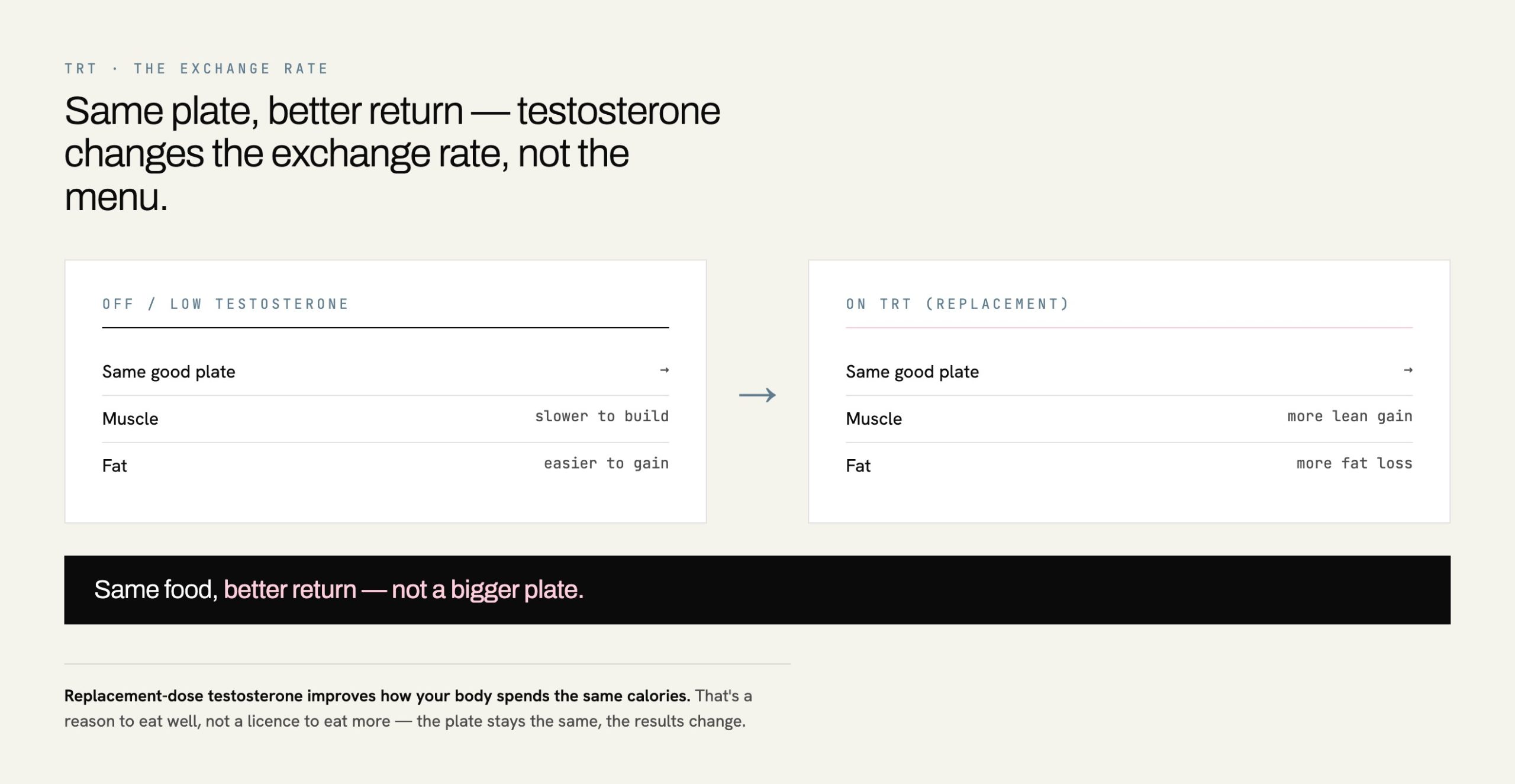
What TRT changes is the return you get on food. Feed a body with healthy testosterone real protein and a reason to grow, and it builds lean tissue and lets go of fat more willingly than it did before. A meta-analysis of fifty-nine controlled trials found testosterone therapy reliably lowered fat mass and raised lean mass.[1] So the same honest eating buys you a better body than it used to. That’s the gift. It is not the same thing as “eat more.”
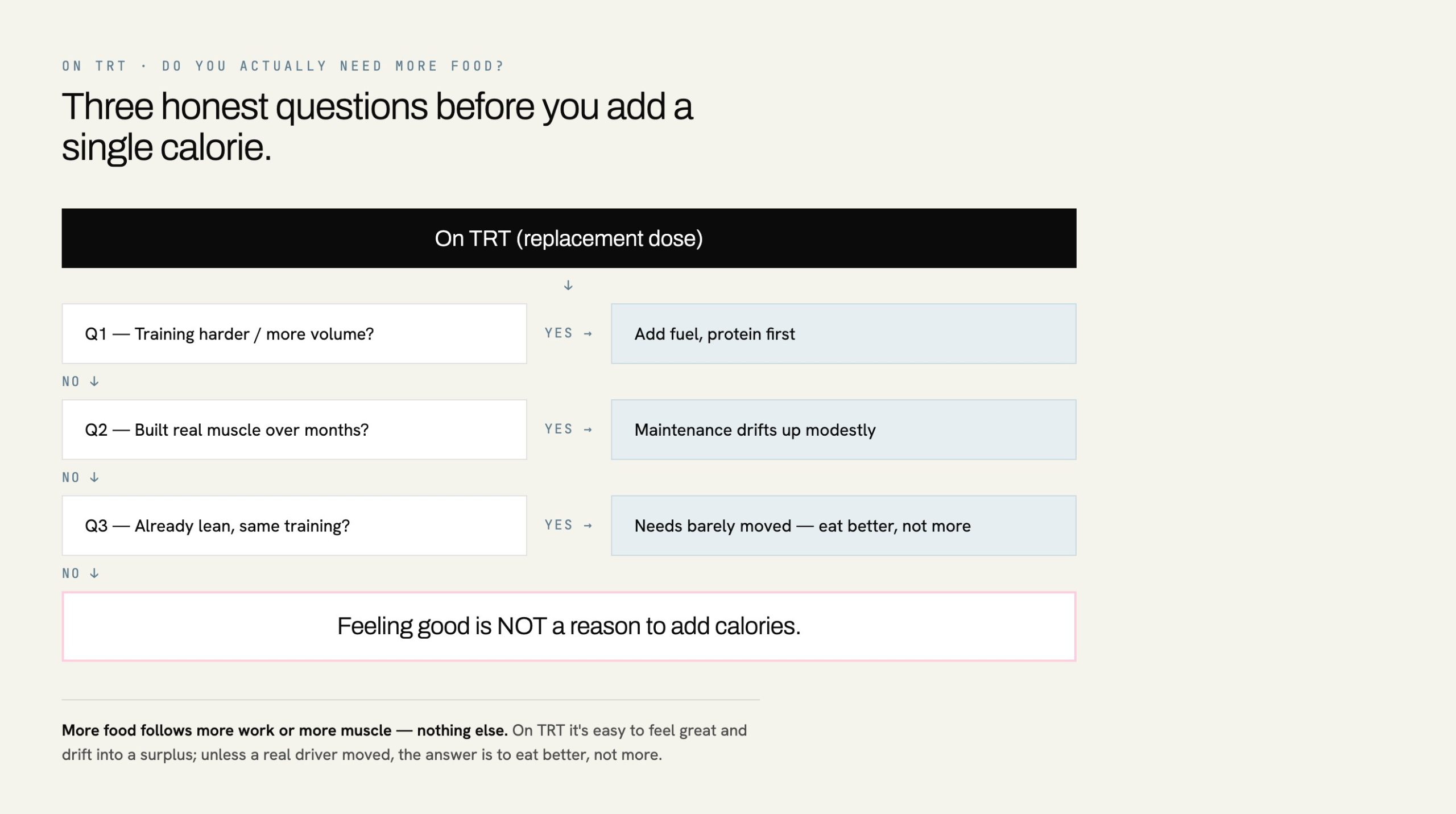
Whether you actually need more food comes down to two things that have nothing to do with the vial: are you training harder now, and are you carrying more muscle than you were? If yes, your needs climbed — and they’d have climbed for a natural man doing the same work. If no, your maintenance is roughly where it was, and eating like it doubled just gets you a gut with better bloodwork.
What actually raises your needs (and it isn’t the testosterone)
Here’s the part that gets tangled. Men feel their appetite pick up on TRT, feel their recovery speed up, and conclude the therapy is telling them to eat more. Half right. The therapy set the stage; the eating gets driven by what you do on that stage.
Training more is the real driver. This was the big one for me. Before therapy, soreness would sit on me for three days and I’d train around it, cautious, half in. On TRT that soreness packs up faster, so I train more often and I train harder. More work means more repair, and more repair genuinely asks for more protein and more fuel. My food went up over the years — but it followed my training up, session by session, not the injection.
More muscle nudges your maintenance. Muscle is metabolically busy tissue. Carry more of it and your body burns a little more at rest, so your maintenance calories drift up over months as you actually build. It’s a modest, earned rise, not a windfall. And it only shows up if you did the building — the therapy plus the training plus the protein. No muscle, no bump.
Appetite that finally tells the truth. The thing nobody warned me about was how steady my hunger got on TRT. Before therapy it swung — ravenous one day, no interest the next. On therapy it flattened into something honest: I get hungry when I’ve trained hard, full when I’ve eaten enough, and both signals mean what they say now. That’s not a command to eat more. It’s a better dashboard. Eating more on TRT is something you do because your training earned it, read off an appetite you can finally trust.
TRT doesn’t hand you extra calories. Your training does. If the work went up, the food goes up to match it — protein first. If the work stayed flat, so should the plate, no matter how good you feel.
The “TRT means eat whatever” trap
Now let me get firm with you, big man, because somebody has to. Does TRT increase appetite? For a lot of men, yes — mine steadied and, on the harder-training weeks, climbed. And that is exactly where men get themselves in trouble. They feel the hunger, feel the recovery, and read it as a license to bury themselves in food and call it “eating for my TRT.”
The therapy makes your body better at using what you feed it. It does not decide how much you feed it. That’s still you, at the counter, with the pan. Eat five hundred calories a day over what you burn and you will gain fat on TRT the same as you would have off it. The math didn’t leave the room when the testosterone walked in. I’ve watched too many men start therapy, ride that first surge of appetite straight into a surplus, and then blame TRT when the gut arrives. The gut wasn’t the testosterone. It was the extra plate they told themselves they’d earned.
And carrying that extra fat costs you twice on TRT specifically. Your fat tissue makes estrogen out of your testosterone, so a soft midsection quietly works against the very thing you started therapy for. “Eat whatever” isn’t just a waistline problem here. It’s a hormone problem you built in the kitchen.
What TRT doesn’t do to your metabolism
People imagine testosterone as a furnace — turn it up and you burn more all day just for existing. That’s not quite how it works, and the distinction matters for your plate.
When researchers suppressed and then replaced testosterone in men and measured their resting energy expenditure directly, the short-term hormone swings produced no measurable change in how many calories the men burned at rest.[2] Testosterone doesn’t crank your metabolism on contact. The way it reshapes your body is through what it lets you build — more lean mass, less fat over months — not by secretly torching calories in the background. So there’s no invisible extra burn you’re now required to feed. The rise in your needs, when it comes, is the muscle you actually put on and the training you actually did.
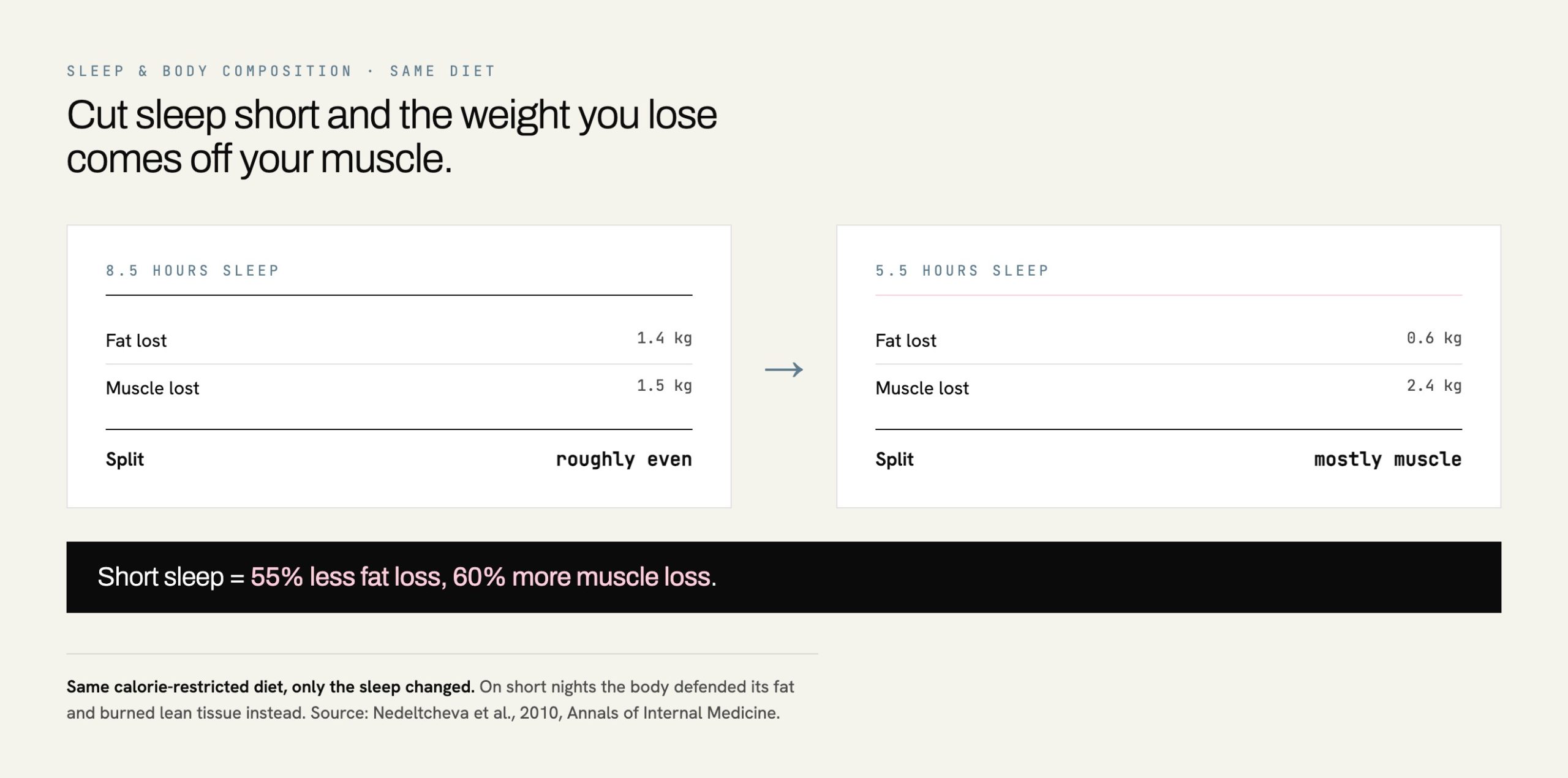
Here’s the flip side, and it’s the good news. Because testosterone protects lean tissue, you can eat at maintenance or even a touch under and still recompose — lose fat while holding or building muscle. In a trial of overweight men on a genuine calorie-cut diet, the ones on testosterone lost almost pure fat and regained more than three kilos of lean mass in the maintenance phase, while the placebo group lost muscle along with the fat.[3] Read that again: they got leaner and more muscular without eating more. On TRT, “better food” often beats “more food.” That’s the whole argument against the eat-whatever crowd, in one study.
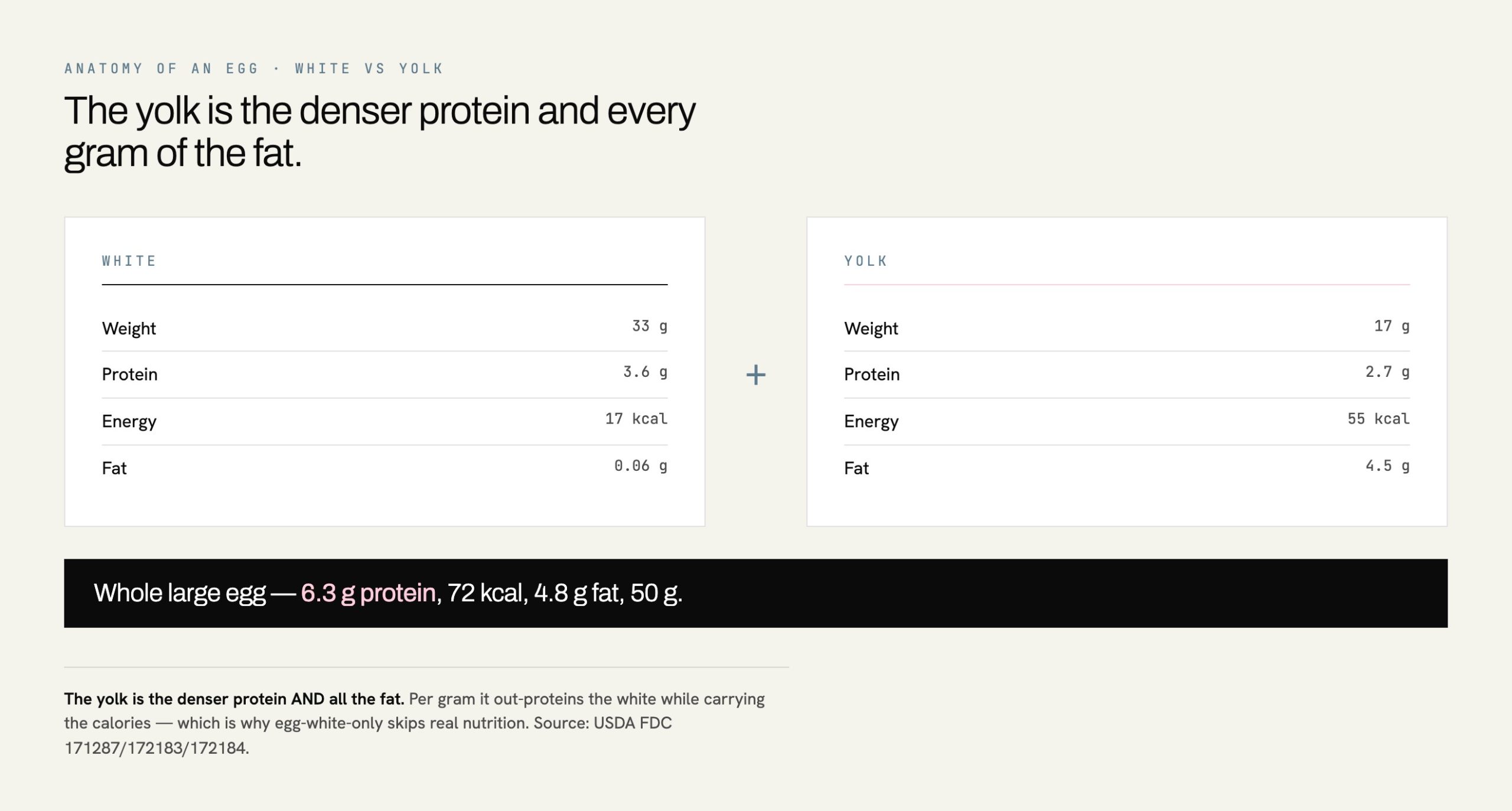
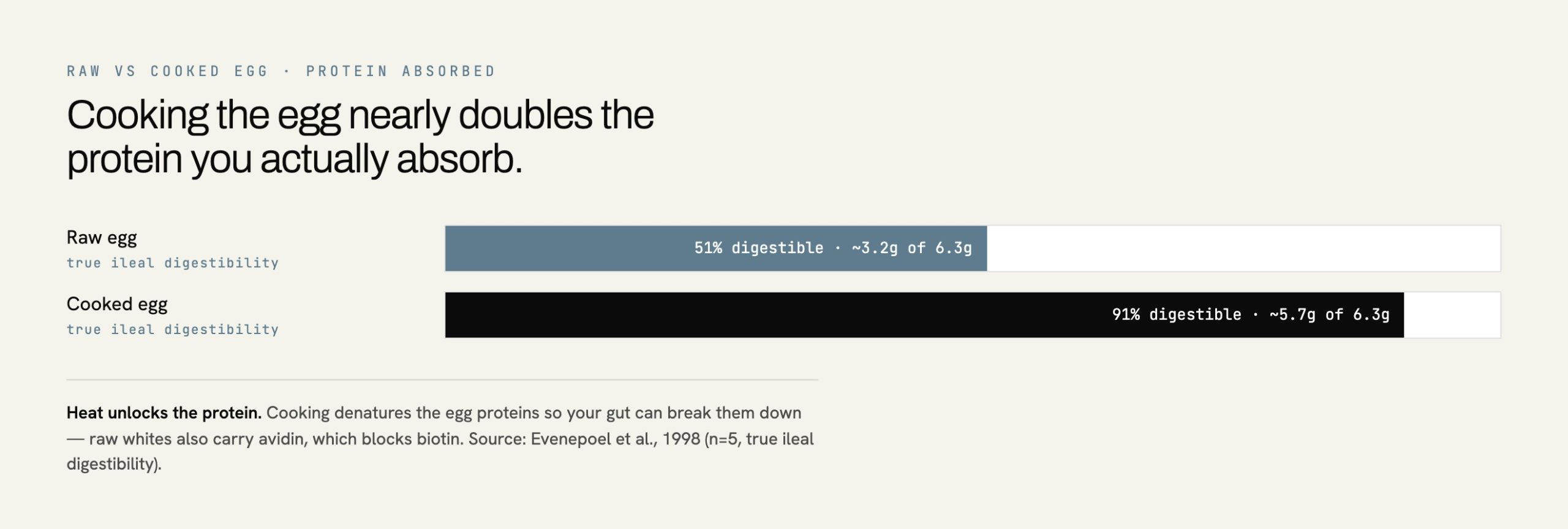
You don’t need a bigger plate to grow on TRT — you need a better one. A 200-gram cooked steak is roughly 55–60g of protein; three whole eggs add about 18g. That single breakfast covers most of a day’s minimum for many men, at maintenance calories. The muscle gets built by the protein and the training, not by the size of the pile.
How my eating actually changed over fifteen years
Let me tell you what really happened, because the year-one version and the man I am now are different people at the table.
Month two of TRT, I did exactly what I’m warning you about. My appetite had picked up and I decided that meant I was supposed to eat big, so I did — bigger breakfasts, second helpings at the family table in Chicago, a “growing man needs it” story I told myself while my kids finished their dinner. Six weeks later the scale was up more than the mirror could explain, and it wasn’t the good kind. I hadn’t trained enough to earn any of it. I’d just heard “TRT” and reached for more food. I pulled it back to what I’d genuinely eat for the work I was doing, let the training climb on its own, and let the food follow the training instead of the hormone. That’s the whole correction. Fifteen years on, my plate is barely bigger than a natural man’s my size — it’s just better aimed, and it lands on a body that finally uses it.
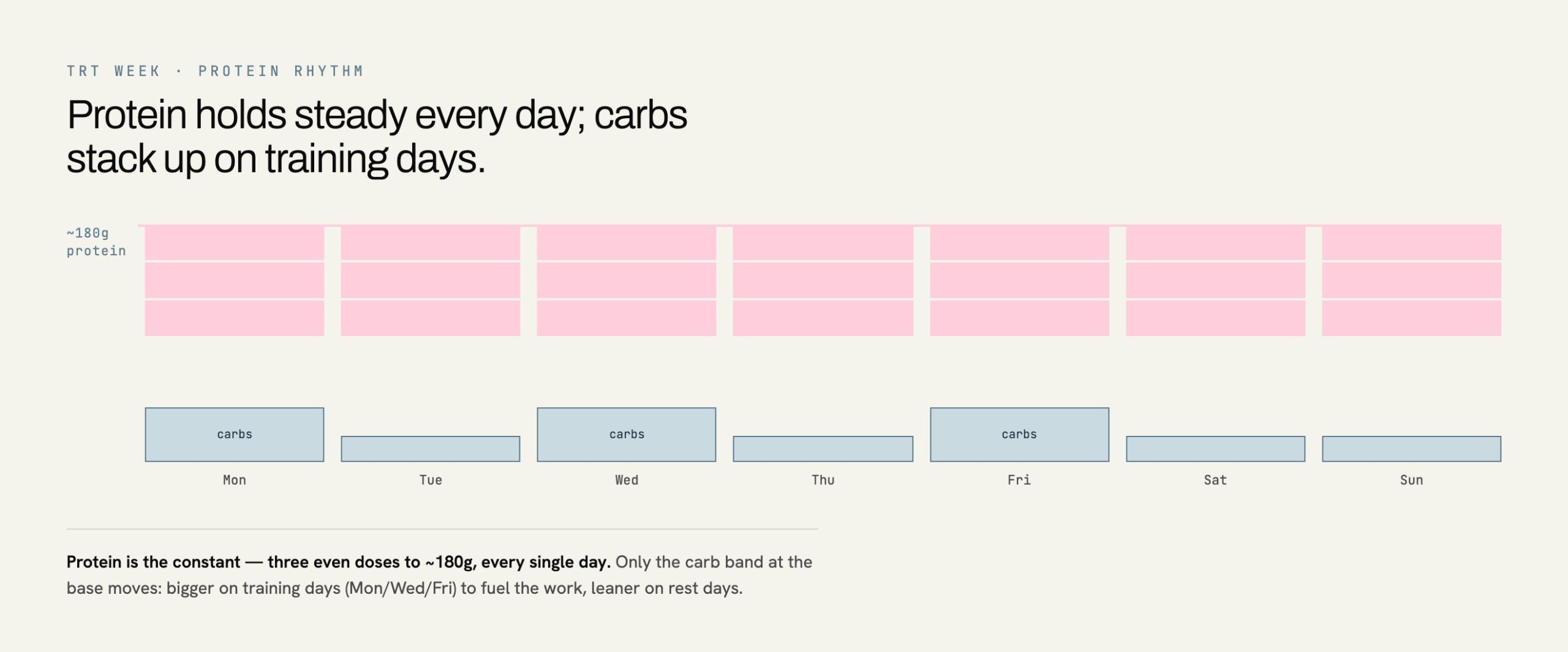
What changed permanently wasn’t the volume. It was the aim. My protein got non-negotiable at every meal. My carbs learned to show up around training and quiet down away from it. My hunger got trustworthy enough that I could stop counting so hard and start reading my own signals. On the weeks I train heavy and often, yes, the food goes up — more rice, an extra meal, a bigger post-session plate. On the weeks life gets in the way and training thins out, the food comes back down without drama, because I’m feeding the work, not the vial.
| Your situation on TRT | Do you need more food? | What I’d actually do |
|---|---|---|
| Replacement dose, same training, already lean | No — needs barely moved | Eat better, not more; protein at every meal |
| Training harder / higher volume than before | Yes — the training earned it | Add fuel around sessions, protein first |
| Built real muscle over months | A little — maintenance drifted up | Let hunger and the mirror set the new normal |
| Feeling great, chasing that “eat whatever” high | No — that’s just a surplus | Nothing extra; that plate becomes a gut and estrogen |
Notice there’s no row where the testosterone itself is the reason to eat more. It’s always the work or the muscle. That’s not an accident. That’s the point.
Protein: the one thing that does go up
If anything on your plate reliably climbs on TRT, it’s protein — and again, because you’re training more, not because the therapy demands it directly. When you recover faster and train harder, your muscle is doing more repair work and it sends the bill in protein.
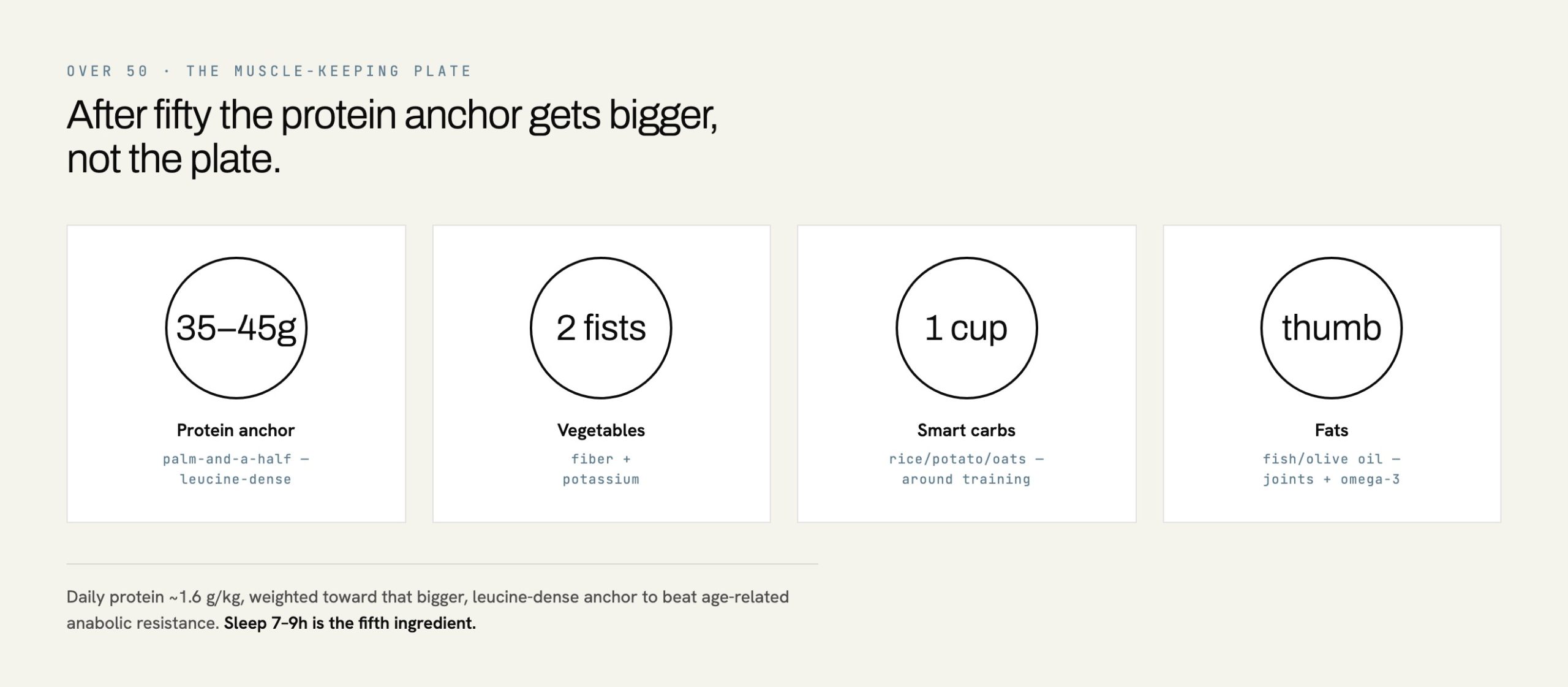
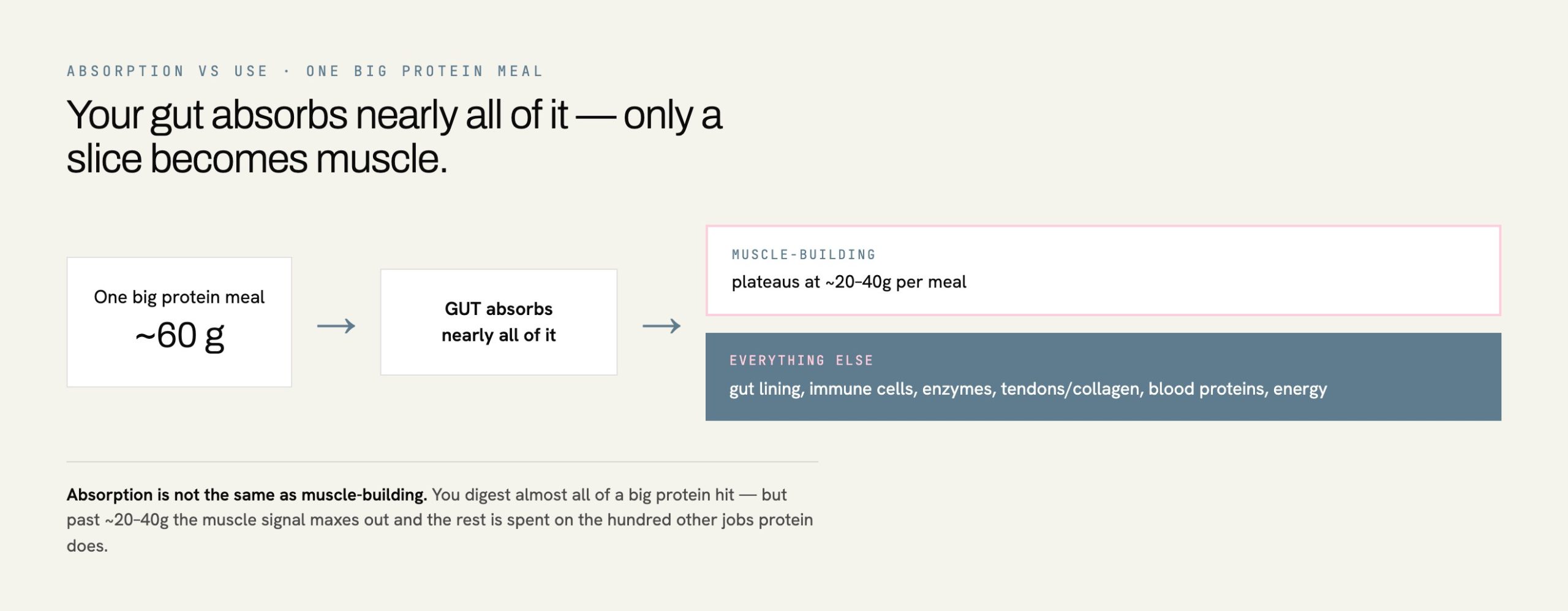
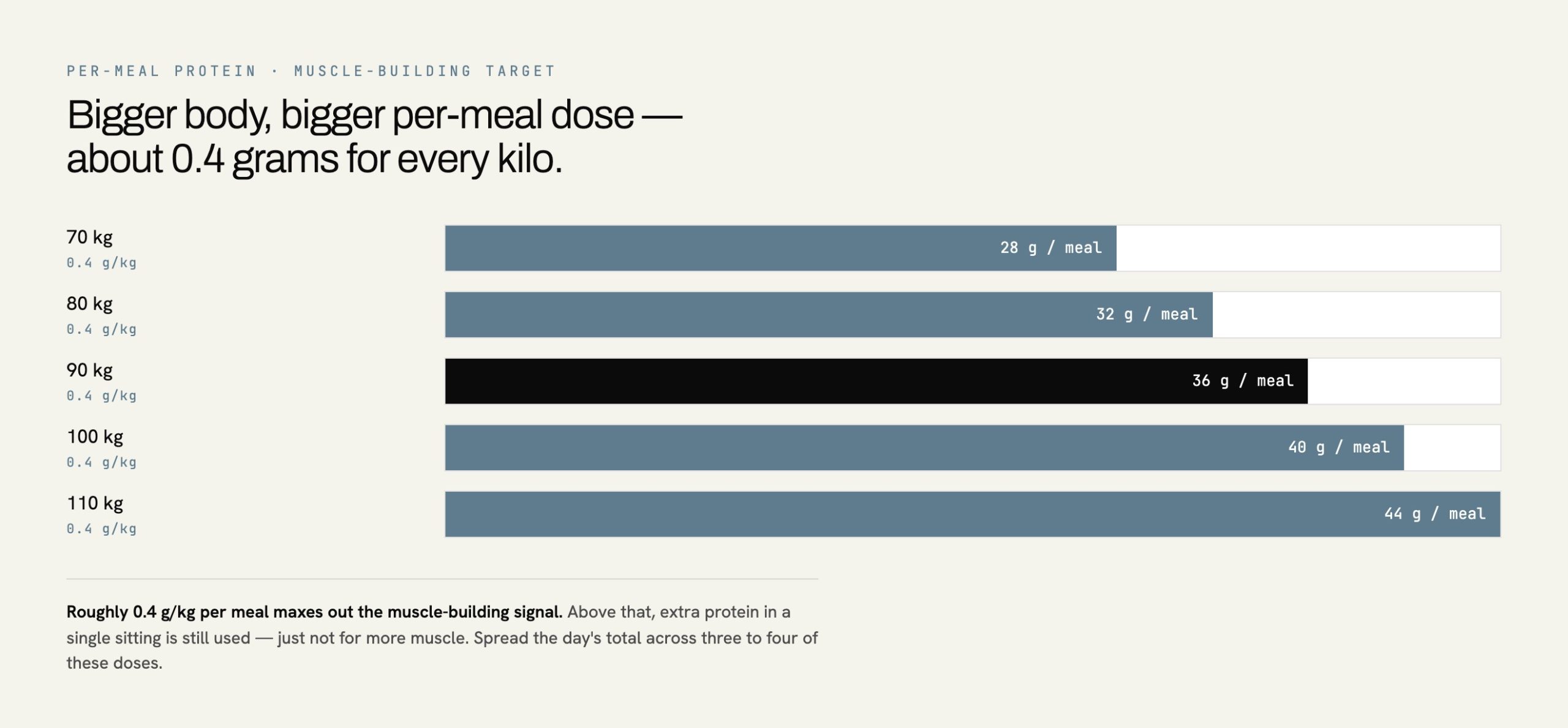
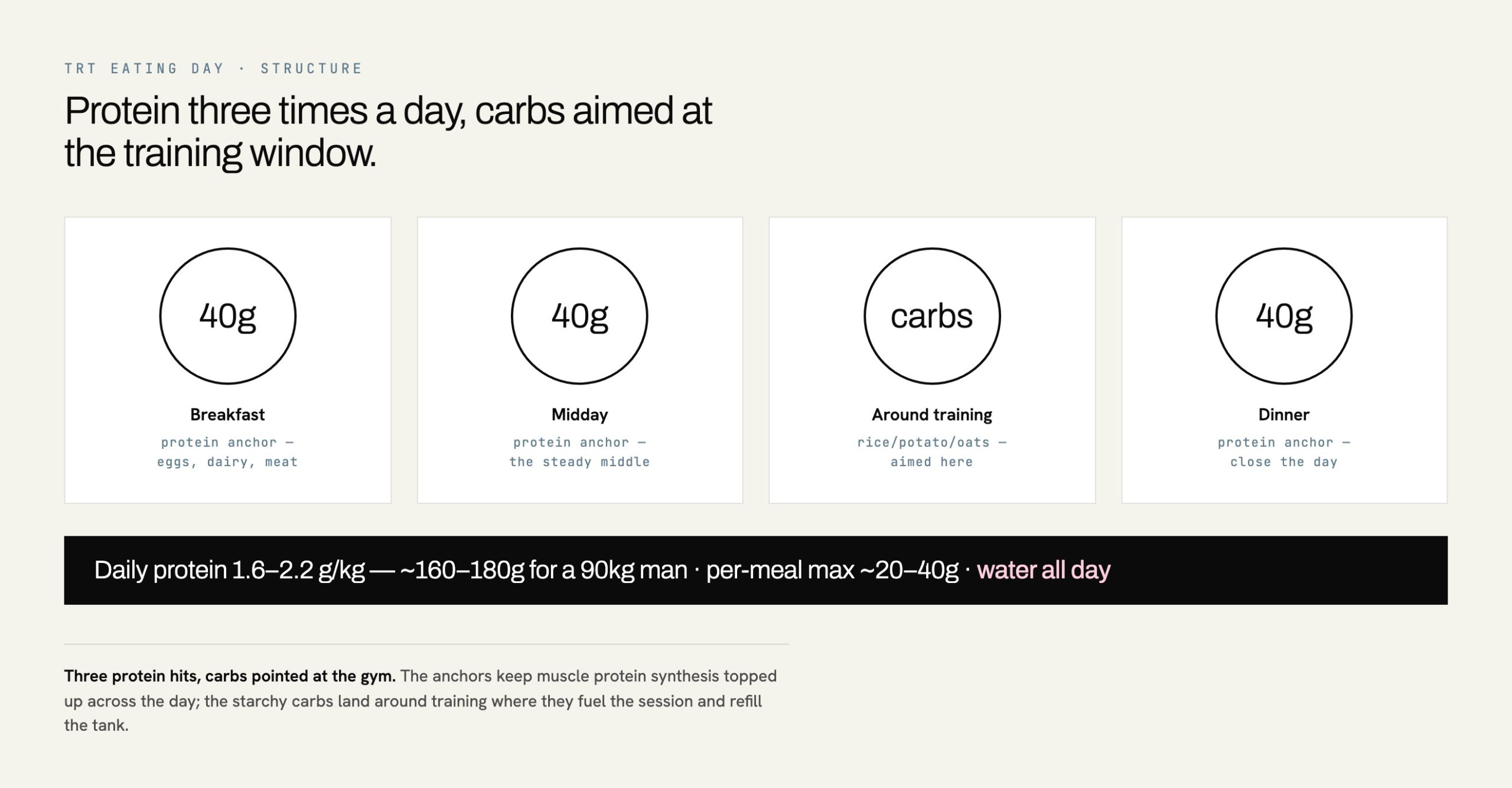
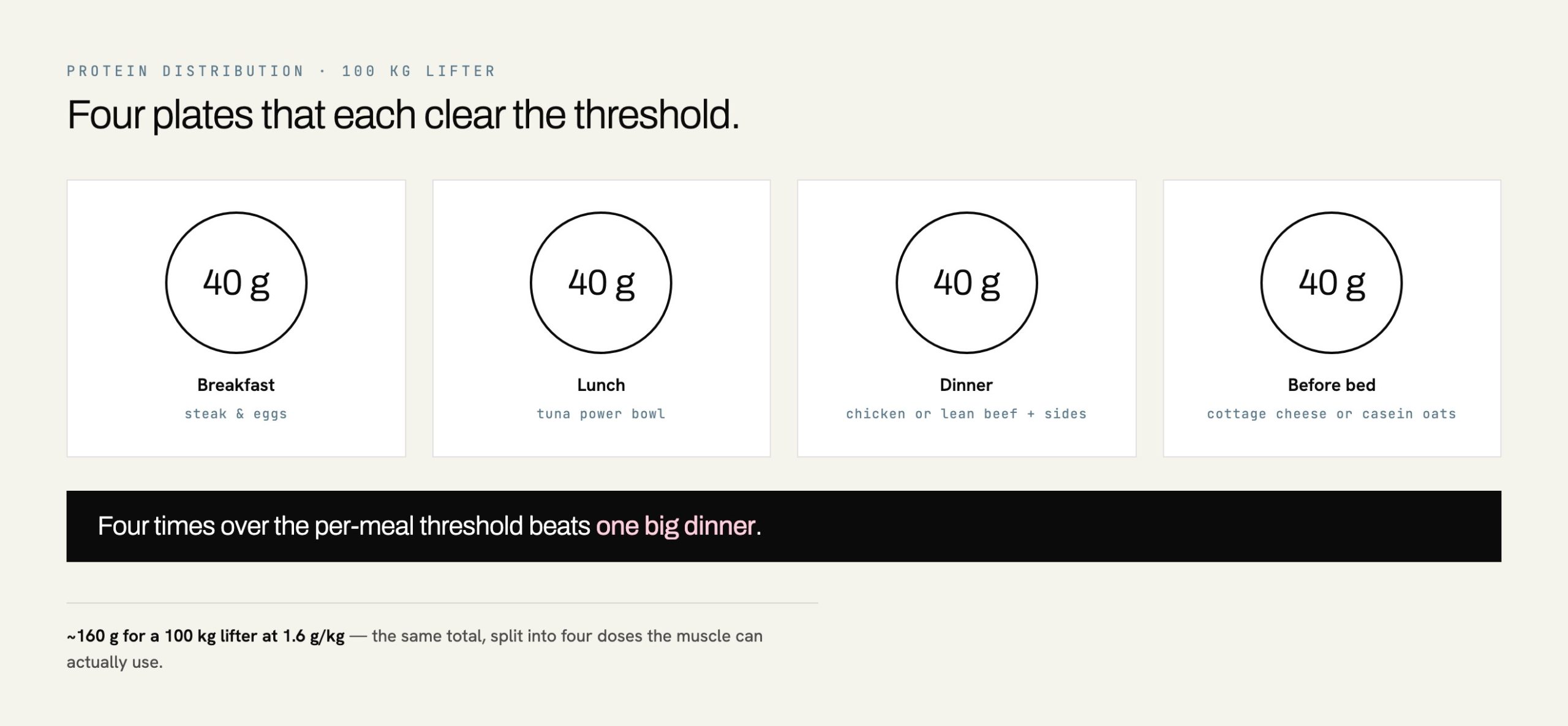
You don’t need to drown in it, though. The research is clear that gains from added protein flatten out past roughly 1.6 grams per kilogram of bodyweight a day; beyond that breakpoint, extra protein stops adding muscle.[4] Most lifters land well between 1.6 and 2.2 g/kg. The move is to hit a real protein source at every meal — forty grams or so, a palm-and-a-half of meat, fish or eggs — and let the total take care of itself.
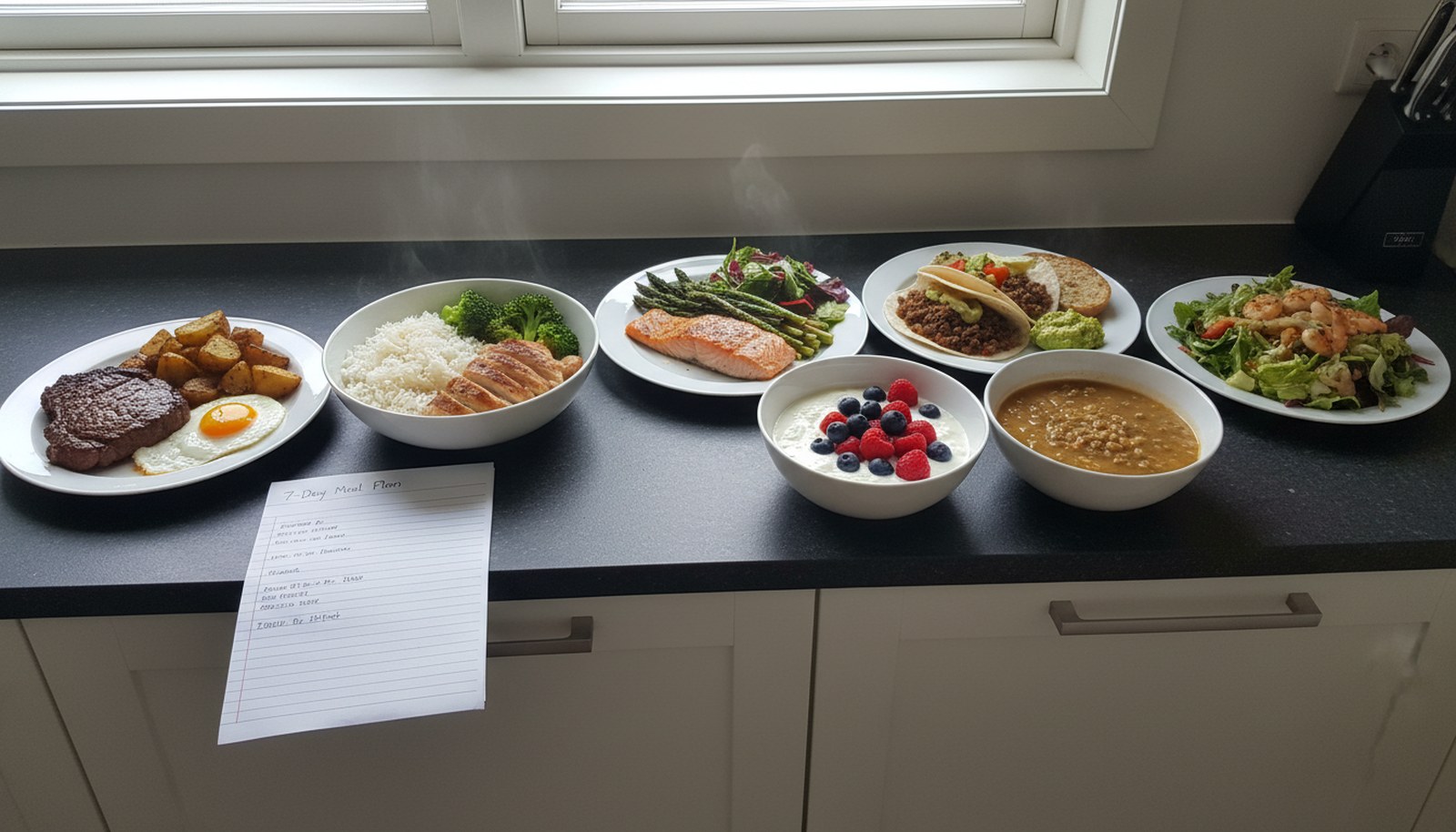
My mornings are often steak and eggs with spinach, protein and iron and greens before the kids are up. Midday I’ll build something like a Mediterranean chicken bowl that’s mostly protein and vegetables with the carbs aimed at a training day. And when I’m short a meal and need the number without cooking, a high-protein cottage cheese bowl closes the gap in about two minutes. None of that is “eating more” for its own sake. It’s making sure the protein actually arrives, which is the one job you can’t skip on therapy.
How to know if you actually need more
Stop guessing from how the therapy makes you feel, and read the real signals instead. Three of them tell you the truth.
Your training. Did your volume genuinely go up — more sessions, more sets, heavier work you’re recovering from? Then your fuel and protein should follow it up. If your training log looks the same as it did six months ago, your plate has no business getting bigger.
Your hunger, over a week not a day. On TRT your appetite gets more honest, so it’s worth listening to — but over a training week, not a single good-mood afternoon. Genuinely hungrier across hard weeks, recovering slowly, feeling flat in the gym? That’s a body asking for fuel. A one-day urge to eat because you feel great is not.
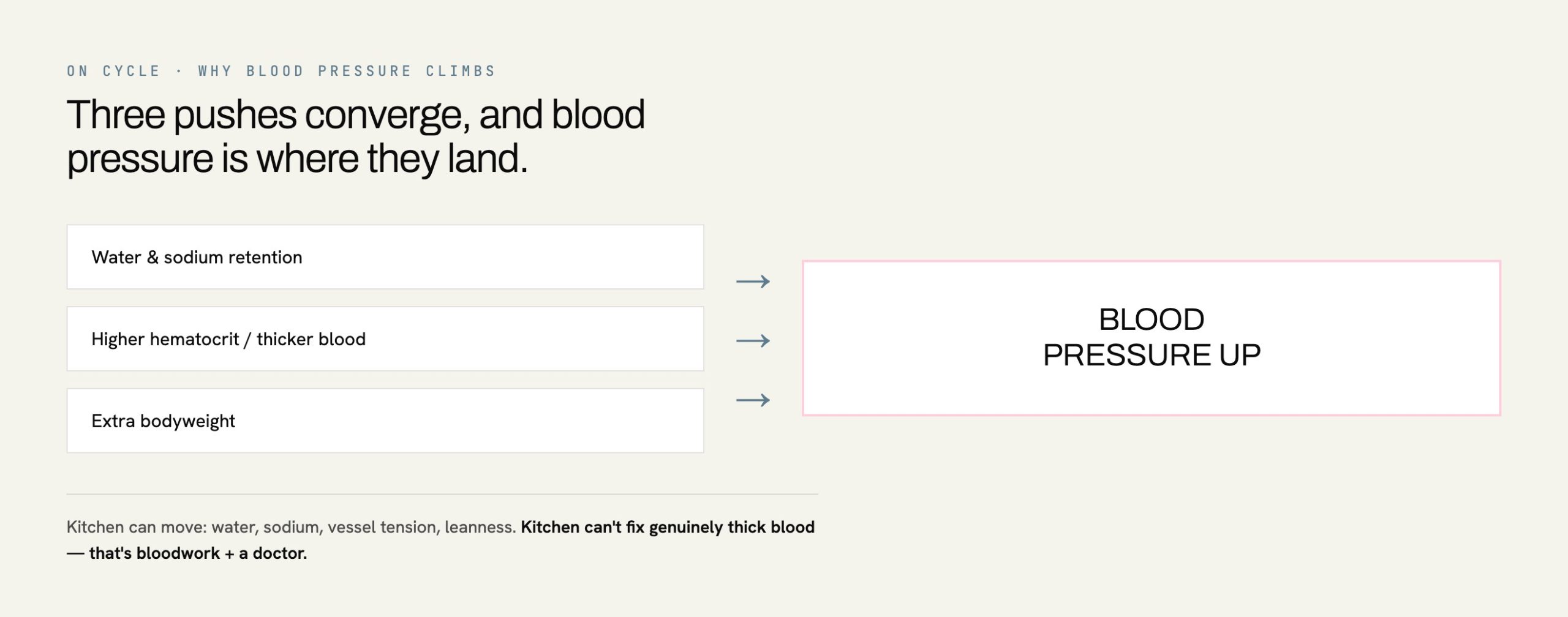
The mirror and the waist, over weeks. The scale lies early on TRT — you may hold water and see the number jump, and that’s fluid, not fat. Watch your waist and the mirror over a few weeks instead. Getting leaner and stronger on your current food? Don’t add. Getting soft? You’re already eating more than you earned.
That’s the whole method. Let the training and the mirror set the amount, keep protein locked at every meal, and let bloodwork with a doctor who knows you keep the rest honest. If you want the fuller picture of eating on therapy, I laid out what changed for me in the testosterone diet, from a man who’s actually on it, and a real week of plates in my full TRT diet plan. This piece is just the honest answer to the one question that trips everyone: more food is something your training earns, not something the vial hands you.
Come get fed, big man. If you want a place to start that already has the protein and the portions built in, my free 7-day plan will feed you well for a week and show you the shape of it — the right amount, aimed right, therapy or not. I’ve got you.
Questions men actually ask
Do you need to eat more on TRT?
Not automatically. TRT isn’t a calorie requirement — it doesn’t add food to your day out of thin air. It improves recovery, steadies appetite, and helps your body build muscle and shed fat on the food you already eat. Your needs only rise if you start training harder or actually put on muscle, and that would raise a natural man’s needs too. If you’re already lean and training the same, eat better, not more.
Does TRT increase appetite?
For many men, yes — but usually it steadies your hunger rather than cranking it. Mine went from wild swings to something honest: hungry after hard training, full when I’d eaten enough. On heavy-training weeks it climbs. That’s a better signal, not a command. Use it to eat the right amount for the work you’re doing, not as permission to eat whatever’s in front of you.
Will TRT make me gain weight if I don’t eat more?
It can move the scale in ways that aren’t fat. Early on you may hold water and see the number jump — that’s fluid, and it settles. If you train, you’ll add lean muscle, which is weight you want. You only gain fat if you eat in a surplus, same as anyone. The scale can’t tell these apart, so watch your waist and the mirror over weeks instead of the morning number.
Can I build muscle on TRT without a calorie surplus?
To a degree, yes — more so than off therapy. Because testosterone protects lean tissue, many men recompose: losing fat while holding or gaining muscle at maintenance calories. Studies of men on testosterone during a calorie cut show they keep or regain lean mass while the fat comes off. You’ll build fastest in a modest surplus with hard training, but you’re not stuck needing to eat big to grow.
How much protein do I need on TRT?
The same evidence-based range as any serious lifter: roughly 1.6 to 2.2 grams per kilogram of bodyweight a day, with the muscle-building benefit flattening out past about 1.6 g/kg. TRT doesn’t change the target; it just makes hitting it pay off more. Anchor every meal with a real protein source — around 40 grams, a palm-and-a-half of meat, fish or eggs — and the daily total takes care of itself.
Why am I hungrier on TRT but not gaining muscle?
Usually because the hunger is going into extra food that isn’t protein, or the training isn’t there to build anything. Appetite rising doesn’t build muscle on its own — protein plus hard training does. If you’re eating more but growing soft instead of strong, aim the food: lock protein at every meal, put your carbs around training, and make sure you’re actually giving the testosterone work to do in the gym.
References
- European Journal of Endocrinology — Corona et al., Testosterone supplementation and body composition: results from a meta-analysis study (2016)
- Obesity (Silver Spring) — Santosa et al., Effects of estrogen and testosterone on resting energy expenditure in older men (2010)
- BMC Medicine — Ng Tang Fui et al., Effects of testosterone treatment on body fat and lean mass in obese men on a hypocaloric diet: a randomised controlled trial (2016)
- British Journal of Sports Medicine — Morton et al., Protein supplementation and resistance training-induced gains in muscle mass and strength: a meta-analysis (2018)

Magnus Olafsson
The cook behind Slim Diet Era. Former Swedish stage competitor (B&K Classic Body Show, Swedish Grand Prix), on TRT since 35, cooking high-protein food in Chicago for his husband, two kids, and you. He counts the macros so you don’t have to.
More about Magnus →Hungry for a plan, not just a post?
Start with the free plan — macros counted, grocery list written, in your inbox. You cook and eat; I’ll do the math.